Ovryde is your Hybrid Banking integration partner. We bring the system and software into your institution through implementation, client onboarding, background-check coordination and ongoing operational support.
Your banking proposition. Our delivery responsibility.
Start with one customer workflow, such as a payment request moving from client preparation to staff review and a recorded outcome. Hybrid Banking provides the platform; Hybrid Chain provides underlying infrastructure. Ovryde scopes and delivers the integration around your business.
The system & software
Hybrid Banking
Modular financial infrastructure for banks, payment institutions, wealth managers and businesses building financial offerings. Compare working non-value Testnet workflows with provider connections that still need activation.
Commercial discovery, institution and client onboarding, background-check coordination, solution design, systems integration, deployment and ongoing support. Scope, responsibilities and acceptance criteria are agreed with your institution.
Ovryde manages the onboarding program and coordinates the checks, evidence and operational handoffs required for the agreed services.
01 /
Institution onboarding
Establish the organization, operating model, jurisdictions, intended clients and service requirements. Coordinate the information and reviews needed to begin the engagement.
02 /
Client onboarding journeys
Design document collection, identity and business-check workflows, review queues and escalation paths around your institution's policies and selected providers.
03 /
Background checks & screening
Coordinate background-check requirements, screening workflows and supporting evidence with the institution and relevant service providers. Agree responsibilities, review criteria and how exceptions are handled.
04 /
Partner & service activation
Bring together provider onboarding, agreements, eligibility reviews and operational acceptance before enabling the selected services.
Client acceptance and regulated decisions remain with the responsible institution or authorized provider. An implementation agreement does not transfer a provider's license or guarantee approval.
The implementation program
From first conversation to an agreed operating model.
01
Discover
Define the proposition
Agree the clients, markets, modules and services you want to support, with a clear delivery scope and commercial proposal.
02
Onboard
Prepare the relationships
Coordinate institution onboarding, due diligence, background checks and the required provider relationships.
03
Integrate
Connect your environment
Plan branding, identity, data, client journeys and institution-specific integrations. For a connected model, your existing core remains authoritative.
04
Validate
Test before activation
Test permissions, exceptions, retries, reconciliation and recovery in non-value Testnet. Agree measurable acceptance criteria before activating production providers.
05
Support
Operate and expand
Provide the agreed support, maintenance and change program as your institution adds capabilities and develops its client proposition.
Explore the product
See Hybrid Banking. Plan your implementation.
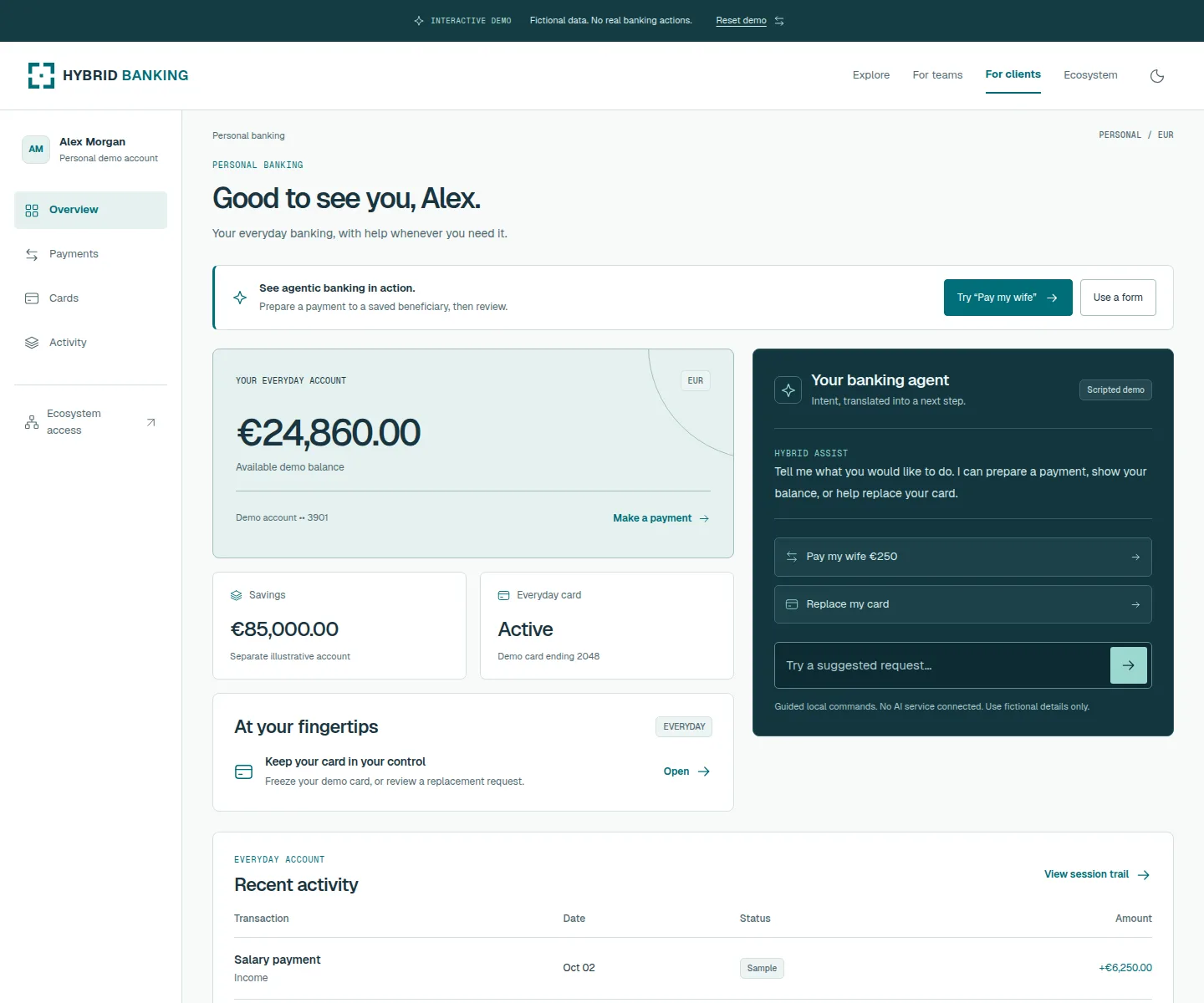
The official product site brings the client experience, team workflows and platform direction together. Ovryde is your next conversation when you are ready to define an implementation.
Hybrid Banking product preview. Fictional demonstration data; no real banking actions.
Hybrid Banking is technology infrastructure, not a bank. The public product includes demonstrations and a Hybrid Core pilot; external payment rails, card issuance and live trading are not connected in that pilot. Existing-core connectors require institution-specific integration. Production scope, provider access and launch readiness are confirmed during the engagement.